Traditional Ṇanra Script
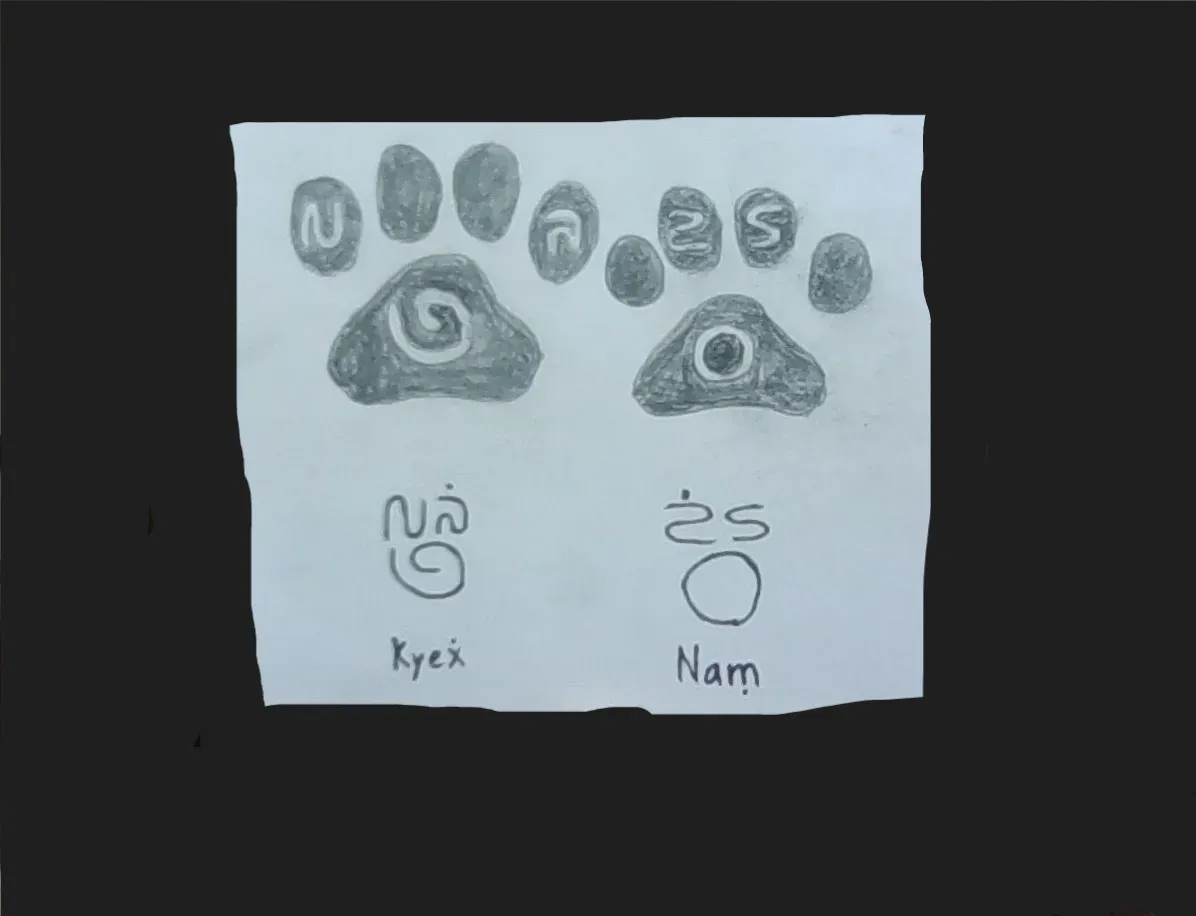
Photo: "Kreẋ Naṃ" written (top to bottom) in Traditional Ṇanra, Modern Ṇanra, and Romanized Ṇanra.
Traditional Ṇanra (pronounced /'n̥ɑ.nɹɑ/) is the traditional script used to write the Kreẋ Naṃ language. The glyphs are arranged in a paw, with each paw indicating a syllable. It is written left-to-right, bottom-to-top. The writing system uses 10 unique glyphs in which the location of the glyphs indicates the position and pronunciation of a sound.
For info on the modern script, see "Modern Ṇanra Script".
History
Traditional Ṇanra was originally created as a way to communicate messages during battles and wars. The script was written by stamping a paw print onto a surface with mud, and carving the glyphs into the mud with claws. The mud could then be washed away once the message was received.
Orthography
See "Modern Ṇanra Script" for info on the glyphs.
Traditional Ṇanra used 10 glyphs, in which the placement of the glyph on the paw indicated what sound the glyph made.
A paw is divided into 3 sections, the initial (left and middle-left "finger"), vowel (bottom "palm"), and final (middle-right and right "finger"). The initial section is the initial consonant, the vowel section is the vowel, and the final section is the final consonant. In the initial and final sections, a glyph placed on the left "finger" is voiceless, and a glyph placed on the right "finger" is voiced.
Syllables don't need to have initial or final consonants. If a syllable has no initial consonant, there will be no symbol written in the left side of the paw, and vice versa. A syllable must always have a vowel, though.
Notice how on the article's thumbnail, the "K" in Kreẋ is represented by a symbol on the left "finger" of the left section, indicating that "K" is the initial consonant of the syllable, and is a voiceless consonant. Now notice that the "ẋ" in Kreẋ is represented by a symbol on the right "finger" of the right section, indicating that "ẋ" is the final consonant of the syllable, and is a voiced consonant.
Note: In Modern Ṇanra, voiced consonants are indicated with a dot above, rather than the location on the paw.