Modern Ṇanra Script
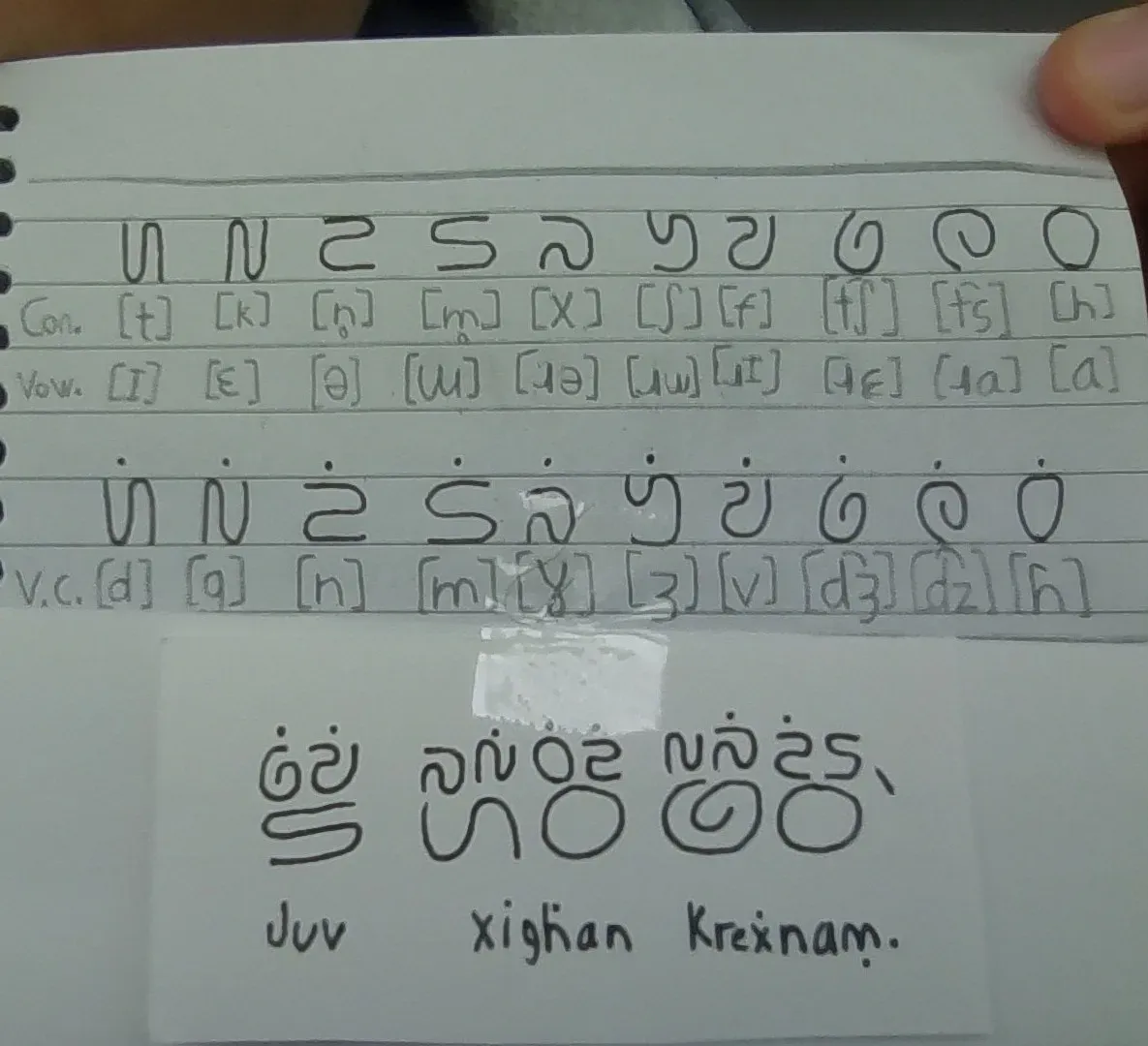
Photo: The glyphs of Modern Ṇanra with "juv xigḣan kreẋnaṃ" written on the bottom. Note that that text is slightly outdated, as I created it before creating Kreẋ Naṃ's case and gender system, and the null letter.
Modern Ṇanra (pronounced /'n̥ɑ.nɹɑ/) is the script used to write the Kreẋ Naṃ language. The glyphs are arranged in syllable blocks, similar to Korean, and is written left-to-right, bottom-to-top.
For info on the traditional script, see "Traditional Ṇanra Script".
History
Modern Ṇanra was developed out of the Traditional Ṇanra script. The Həkreẋ people needed a way to write the Ṇanra script with pens, rather than with paw prints and claws.
Orthography
Modern Ṇanra uses 10 glyphs (or 20, depending on how you count). Glyphs written in the top left are initial consonants. Glyphs written in the top right are final consonants. Glyphs written in the bottom are vowels. Consonant glyphs with dots over them are voiced.
A certain glyph called a null letter, which makes no sound, is used when there is no initial and/or final consonant. For example, hu would be written with a null letter in the final position, because there is no final consonant. The word um would be written with a null letter in the initial position, because there is no initial consonant. The word a would be written with a null letter in the initial and final position, because there is no initial consonant or final consonant.