Browse
Discover 1173 public constructed languages
Askarian
by Isaac
A language for a micro nation takes inspiration from Russian and old English, but follows some English rules as well
Kredomir
by Quill
Proto-Kretamir language
sumary gamma
by Nubank
uma linguagem simples para criar sua inteligência artificial
Saipi
by Sebastian Aspinwall
Spoken by the people in the country of Sapiko
Winlask
by Ethan Crossman
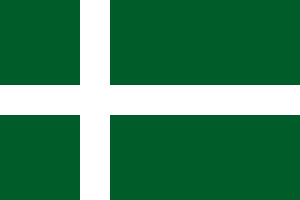
Winlask (Winlask: Winlask [ˈwin.lask]) is a North Germanic language spoken primarily in Winland, a sovereign state located in northeastern North America. Descended from the Old Norse dialects brought by Greenlandic settlers between the 10th and 14th centuries, Winlask developed through centuries of contact with Eastern Abenaki and other Indigenous languages of the region. As a result, it differs substantially from other North Germanic languages in its sound system, grammar, and vocabulary while retaining a predominantly Norse origin. Winlask is the native language of approximately 6.8 million people and serves as one of the official languages of Winland alongside English and Eastern Abenaki. The language evolved from the now-extinct Greenlandic Norse branch and is considered by linguists to be its sole surviving descendant. Today, Winlask is used throughout government, education, media, literature, and public life, and forms an important part of Winlandic national identity.
Katur
by Mr. Blockz
Old Katur was used by the Katuri people of the region of the southern sun
Spinta
by Willa Song
Spinta is the language of the Spintoran people of the desert region of Spintora.
Qarluai
by Ayham Elkhalifa
a conlang of sky and ground
Lòa Lòa
by DwaveThePebble
Lòa Lòa (pronounced /lo̞ːä lo̞ːä/, means "very hot") is a language spoken by a people located on the planet of Tria Asteria, which orbits Polaris. It has SOV word order.
Druvski
by Joe
A slavic language. Word order: SVO & SOV & OSV (VERY flexible, all word orders are common).
Sonag
by Coby Scarpaci
Docket
by Alex MikNally
Selado
by Mîng Thàn Erundil
Esperanto-ish auxiliary conlang but for Mainland Southeast Asia
Alogra
by Veofree Veofree
algora
Tsang'hi Language
by Vorsitzenderin Sofia
Tsang’hi (/tsaŋˈhi/) is the largest surviving Oayi language and the best-described member of the Oayi branch, preserving the family’s tonal-harmonic system in its most productive form. It has a compact segmental inventory centred on /m n ŋ ʙ ħ ʘ/ and a six-vowel system /a e i ɨ o u/, with a strong preference for closed roots such as VC, CVC and CVCC. Each vowel-bearing syllable carries one of three tonal readings: falling citation, central linked/topical, or rising affected/processual, producing larger tone grids in compounds. Its phonology is shaped by vowel harmony, consonantal drift, and final nasal whistle releases, with /ŋ n m/ giving high, middle, and low offglides respectively. Morphosyntactically, Tsang’hi is analytic to lightly compounding, with freer clause order than its lexical layout suggests, tone doing much of the grammatical work normally handled by inflection.
Minegomarian
by John Doe
Bomadalaian
by John Doe
Barbamarian
by John Doe
Neredrossian
by John Doe
Hharagilattian
by John Doe